Shared desk routine is a narrow desk question, not a generic tidy-up task. A short shared-desk routine for making a clamp holder legible to the next person without personal labels. The useful evidence comes from the actual materials, movements, and equipment at the intended location, because a holder that looks plausible in a product image may meet a completely different desk interface in use.
A shared routine is a small piece of furniture literacy. It tells the next person where an object rests, where a cable travels, and what physical issue should be reported without making assumptions about anyone’s body, device, or work style. The best routine can be learned from one ordinary pickup and return. It does not need labels that personalise the desk or a complicated sequence that collapses during a busy day.
Define a neutral return state
Shared equipment needs a visible starting point. For a headphone holder, neutral can be as simple as headset on the hook, cable resting in its designated clips, connector unplugged or parked where local policy allows, and the desk surface clear. This is a return point, not a personal configuration.
Keep the definition tied to objects rather than people. A note such as “return cable to underside clips” is practical; a note naming one person’s preferred setting is not. The desk should remain usable for different work styles, devices, and privacy expectations.
A neutral return state should describe where equipment rests, not who previously adjusted the desk. For this guide, define a neutral return state is the immediate checkpoint; record the observed condition and its next question before moving to another desk decision.
Make the holder easy to notice
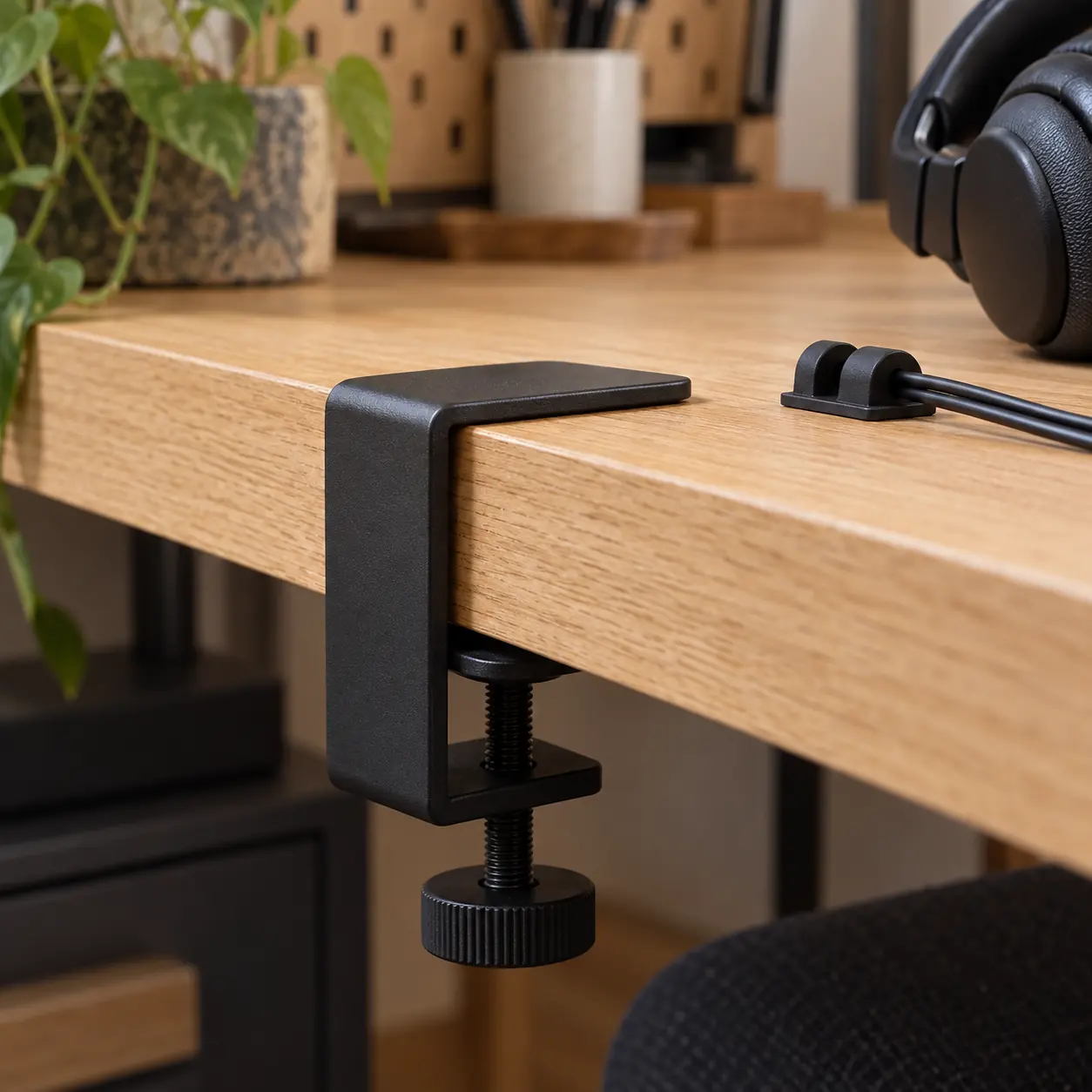
A clamp holder can disappear beneath a desk edge, especially for someone new to the workstation. Choose a location that is reachable without putting a hand near cables, drawers, or a chair path. The aim is legibility through placement, not added signage or decorative labels.
During the first handoff, point out the hook and trace the cable route once. A thirty-second orientation is more useful than a long instruction sheet, because it shows the actual path and the movements that should remain clear. Keep the explanation descriptive rather than prescriptive.
A holder that is easy to notice reduces the need for labels and memorised instructions. For this guide, make the holder easy to notice is the immediate checkpoint; record the observed condition and its next question before moving to another desk decision.
Separate equipment boundaries
A shared holder may store a shared headset or provide a temporary rest for personal equipment, but those arrangements have different hygiene, access, and policy questions. Decide locally which use applies and do not imply that a hook resolves those questions by itself.
If a headset is personal, keep its adapter, microphone cover, charging lead, and account-specific device connection separate from the shared desk routine. The storage hardware can reduce clutter; it should not blur ownership, consent, or workplace policy around audio equipment.
Storage hardware can reduce clutter without resolving separate questions of ownership or access. For this guide, separate equipment boundaries is the immediate checkpoint; record the observed condition and its next question before moving to another desk decision.
Use a cable reset check
At the end of a desk session, run one visual check: cable follows the intended edge, does not cross the chair or drawer path, and has not been pulled from a clip. This takes less time than untangling a lead after it has slipped behind a cabinet.
If the cable repeatedly leaves the route, treat that as design feedback. The holder may be on the wrong side, the slack may be misplaced, or the desk may need fewer but better-positioned clips. A routine works when it reflects real movement, not when it relies on perfect compliance.
A visual cable reset catches drift before a hidden loop becomes a chair or drawer problem. For this guide, use a cable reset check is the immediate checkpoint; record the observed condition and its next question before moving to another desk decision.
Keep handoffs low-friction
Avoid requiring a sequence of clips, straps, and drawers just to take a call. The shared routine should allow a person to lift the headset, connect it, and work without undoing someone else’s arrangement. Complexity often becomes invisible clutter after a few busy days.
Ask a second user to try the pickup and return path. Their first attempt can reveal an assumption hidden by familiarity: a hook too low to see, a cable that routes behind the chair, or a drawer that cannot open while the headset is stored. Revise the desk, not the person.
A second user can reveal a handoff assumption that familiarity has made invisible. For this guide, keep handoffs low-friction is the immediate checkpoint; record the observed condition and its next question before moving to another desk decision.
Record maintenance without surveillance
A shared desk can keep a simple equipment note: clip lifted, clamp moved, cable frayed, or holder contact pad missing. Record the object and issue rather than the person who last used it. This is enough for a facilities or owner conversation without collecting unnecessary usage detail.
The useful result is a shared surface that resets cleanly and reports actual hardware issues. It does not promise equal fit, audio quality, or productivity for every user. Its value is narrow and practical: fewer surprise snags, a known storage point, and a clear way to flag a problem.
A factual equipment note helps a shared desk evolve without treating a physical issue as personal. For this guide, record maintenance without surveillance is the immediate checkpoint; record the observed condition and its next question before moving to another desk decision.
What this check carries forward
A shared routine is strongest when it describes the furniture rather than the people who use it. The hook is under the left edge; the cable follows the underside; the drawer must remain clear; a lifted clip is reported as equipment. Those statements remain useful when the desk is reassigned. By contrast, labels built around a particular person’s preferences can make a common workstation less welcoming and hide the fact that desk height, headset type, privacy expectations, and task patterns vary from user to user.
The moment of handoff is where a simple route proves its value. A reader should be able to see where the headset returns, understand how the cable reaches its connector, and move the chair without discovering a hidden loop. If that is not possible, simplify the route or relocate the holder before adding instructions. Good shared infrastructure reduces the number of things someone must remember; it does not produce a longer list of rules for navigating someone else’s arrangement.
When a shared arrangement stops working, record the physical symptom first: hook blocked by new drawer unit, cable now crosses chair path, pad missing, or clip lifting. This gives the next owner a useful maintenance question. It also avoids making a desk issue personal. The routine’s success is modest but valuable: it makes an accessory easier to reset, observe, and change without collecting more information about its users than the setup requires.
A routine should still work when its original author is not present. That is why it should be visible in the furniture, not hidden in personal memory. The headset returns to one place, the lead follows one clear path, and a physical failure has a narrow way to be reported. This makes a shared desk friendlier without pretending that shared equipment eliminates individual choices about devices, privacy, or preferred work habits.
A shared-desk routine has carried forward enough information when another person can return the headset without receiving a personal rulebook. The visible hook, the short cable route, and the note for a lifted clip should tell the essential story. Keep exceptions narrow: an ownership question belongs with the owner or workplace policy, while a blocked drawer or frayed lead belongs in an equipment note. This distinction prevents a simple storage system from collecting unnecessary information about its users. It also makes revision easier, because the next change begins with an observable desk condition rather than an assumption about how someone worked.
Use the next note, not a bigger claim
After a handoff path is clear, inspect the physical route rather than adding more reminders. The cable map can show where a loop crosses a drawer path, while the upkeep note can record a lifted clip or changed desk hardware. Keep the shared routine focused on visible furniture and equipment states. A short first-use walk-through can reveal whether the hook and cable remain understandable from a seated position.
Return to the main Deskline Register field report for the complete field method. Its linked notes support a calm reset by separating hardware questions from ownership, policy, and personal preference, which a static desk guide cannot settle on its own.