Headphone clearance is a narrow desk question, not a generic tidy-up task. Check clearance around a clamp holder so the stored headset does not trade visual tidiness for collisions. The useful evidence comes from the actual materials, movements, and equipment at the intended location, because a holder that looks plausible in a product image may meet a completely different desk interface in use.
The clearance review is most accurate when it includes the actual headset and the actual desk user. Ear cups, a microphone boom, chair arms, knees, drawer pulls, and a cable loop all occupy real space. Holding the equipment in the intended location and walking through normal movement reveals a practical envelope that a hook dimension alone cannot express. This guide keeps that envelope visible before the clamp is fixed.
Measure the hanging envelope
A hook needs more than the width of the headband. The earcups, cable, hook profile, and hand reaching for the headset all occupy space. Estimate the hanging envelope with the headset held at the planned height and note the furthest point from the desk edge.
Compare that envelope with the space below and beside the desk. A shallow cabinet, desktop tower, chair arm, or wall can turn an apparently empty zone into a collision point. The measurement is an access check, not a claim about headset protection or fall resistance.
The headset’s earcups, boom, cable, and hand path all extend beyond the dimensions of the hook. For this guide, measure the hanging envelope is the immediate checkpoint; record the observed condition and its next question before moving to another desk decision.
Check seated knee and chair paths
A holder mounted under the front edge may be close to legs, while one near a side return may meet an armrest as the chair turns. Sit in the usual position and roll through the range of ordinary movement before installing. A stored headset should not become a surprise obstacle beneath the desk.
Repeat this check while standing and while pulling the chair away. The path changes when a chair swivels or a footrest is moved. If the headset enters that path, move the holder rather than relying on everyone to remember a fragile clearance rule.
A seated pivot reveals clearance information that cannot be seen from a standing front view. For this guide, check seated knee and chair paths is the immediate checkpoint; record the observed condition and its next question before moving to another desk decision.
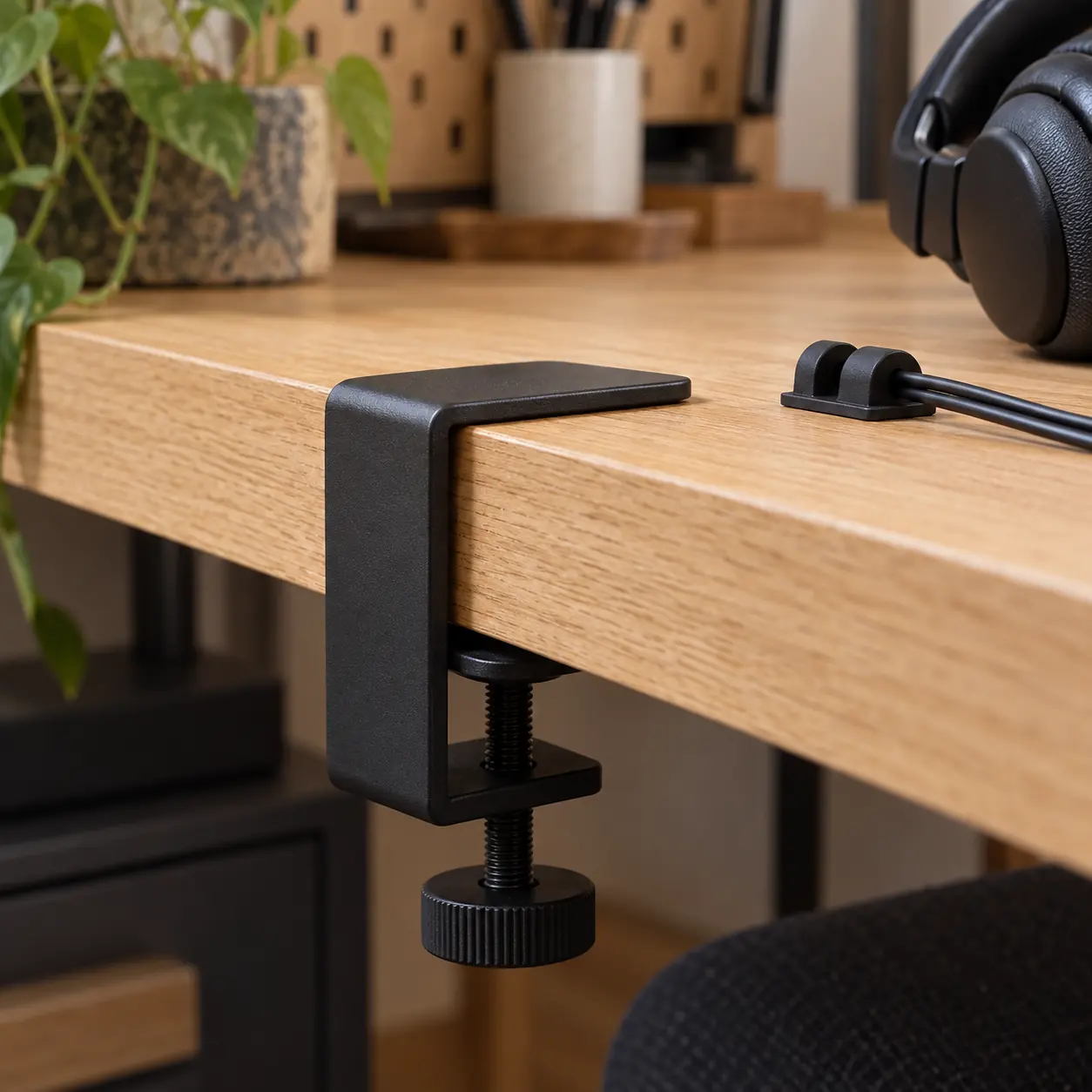
Open nearby storage completely
Drawers, slide-out trays, filing units, and cabinet doors deserve a full-range check. A holder that is clear when a drawer is closed can collide at the last centimetres of travel, where the user may not be watching the headset. Hardware should respect the motion already built into the desk.
Use a slow open-and-close pass with the headset in place. Watch the cable as well as the earcups; a cable can hook a drawer handle or rail before the headset itself makes contact. This one practical test often separates a convenient location from a merely available one.
Drawers and pull-out trays need their complete travel checked with the stored headset present. For this guide, open nearby storage completely is the immediate checkpoint; record the observed condition and its next question before moving to another desk decision.
Keep the headset’s own shape in view
Headsets vary in headband stiffness, earcup depth, microphone boom position, detachable cables, and charging ports. A generic hanger can be considered only after the actual headset is held against it. Do not assume that a soft headband or a flexible boom makes any hook a fit.
Check whether the headset rests on a broad support area and whether a boom or cable hangs without a sharp bend. Follow the holder and headset maker guidance where it exists. The article can help identify questions, but it cannot certify the interaction between two specific products.
The actual headset shape matters more than a generic expectation about over-ear equipment. For this guide, keep the headset’s own shape in view is the immediate checkpoint; record the observed condition and its next question before moving to another desk decision.
Plan access for quick transitions
A storage point should make a short call easier, not create an extra sequence of moving cables and clearing objects. Practice picking up the headset, sitting down, connecting it, and returning it. Notice whether the route stays intuitive when attention is on work rather than the hardware.
If the action needs two hands because the cable catches, the hook is hidden, or a drawer must be moved, reconsider the site. The best location is often a little less visually perfect but more available to the person who actually uses the desk.
A quick pickup and return test exposes a location that adds friction to a short call. For this guide, plan access for quick transitions is the immediate checkpoint; record the observed condition and its next question before moving to another desk decision.
Leave a safe fallback
Even an organized desk changes: a guest uses the chair, a desktop computer is moved, or a new headset has a different shape. Keep one alternate storage location in mind rather than treating the chosen clamp point as permanent. That makes a future change a small remap rather than a forced compromise.
The final test is simple: headphones hang without a collision, cable stays out of the moving path, and the desk user can move normally. When one of those conditions is absent, the clearance check has done its job by revealing a choice before installation.
A reversible location keeps a future change from turning storage into a crowded compromise. For this guide, leave a safe fallback is the immediate checkpoint; record the observed condition and its next question before moving to another desk decision.
What this check carries forward
Clearance is partly a question of scale. A compact pair of headphones may fit beneath a side return while a larger headset with a boom microphone, thick headband, or attached cable needs a wider envelope. The holder cannot be evaluated from the hook alone. Hold the actual headset at the proposed location and let its earcups, cable, and access path describe the space they require. That simple physical rehearsal is more informative than estimating from a product thumbnail or assuming that all over-ear designs occupy the same shape.
The desk user also has a clearance envelope. Knees, chair arms, a footrest, a bag placed under the desk, and the turning path of the chair all matter in a way that a static elevation drawing can miss. A holder that is perfectly clear from a standing view may become an obstacle in the first seated pivot. Test the movements in the order they occur during work, because the normal approach is where the real collision is most likely to appear.
If space is close, choose the location that is easier to revise. A hook at a clear side edge may be a better long-term choice than one tucked beneath the front simply because future furniture changes will be easier to see. The goal is a reversible, legible storage point. It is not to place every accessory as near to the user as possible or to make a crowded desk appear empty from one angle.
The final clearance note can be as direct as “headset clears drawer at full extension” or “chair arm meets earcup when turning.” Those statements are not ratings; they are practical facts that make the next placement decision more reliable. A holder belongs where the equipment rests without narrowing the ordinary use of the desk. If the space is not there, a different storage idea is better evidence of good judgement than a squeezed installation.
Clearance work carries forward as a movement rehearsal, not a dimension claim about every headset. Preserve the result of the seated pivot, the drawer test, and the pickup path with the actual earcups and cable in place. That lets a later user see why the hook sits on one side instead of under the front edge. It also exposes the consequence of a new chair, cabinet, or headset before the arrangement is treated as fixed. When the stored equipment narrows an ordinary path, move the storage point or choose another method. A holder is successful only when the surrounding desk can still perform its ordinary movements.
Use the next note, not a bigger claim
A successful clearance rehearsal still needs a cable path that stays out of the same moving zones. Use the route map to trace the lead from device to hook, or revisit the edge audit when a cabinet or drawer makes the current position too tight. The headset’s envelope should remain visible during both checks.
Return to the main Deskline Register field report for the overall method. The linked notes divide the work into interface, pressure, route, handoff, and upkeep so a single narrow clearance observation is not mistaken for a universal fit conclusion.