Desk edge audit is a narrow desk question, not a generic tidy-up task. Identify usable thickness, lips, bevels, finish risk, and nearby furniture before a clamp enters the picture. The useful evidence comes from the actual materials, movements, and equipment at the intended location, because a holder that looks plausible in a product image may meet a completely different desk interface in use.
The edge audit works best when it ends with a sketch, not a verdict. Mark the thickness at the real gripping zone, the closest apron or rail, the drawer sweep, and the finish question. Those four marks describe why an edge is usable or why it should be left alone. They also make it possible to compare a holder manual against the desk without relying on memory after furniture is moved.
Find the actual gripping zone
A desk edge is not a single measurement. A top that looks substantial from above may have a shallow apron, a beveled underside, or a cable tray that leaves only a narrow strip for a clamp to meet. Start by locating a section where the upper and lower pads can make parallel, unobstructed contact.
Use a ruler or a folded paper strip to record the thickness at the intended spot, then look a few centimetres left and right. This reveals a taper, support rail, or edge treatment that a product photo will not show. The useful result is a small map of a real gripping zone, not an assumed desk category.
A lower rail changes a clamp decision even when the desktop looks generous from above. For this guide, find the actual gripping zone is the immediate checkpoint; record the observed condition and its next question before moving to another desk decision.
Read the underside as carefully as the top
The underside often decides the installation. An apron can interrupt a tightening screw; a pull-out drawer can collide with the clamp body; a metal rail can make a seemingly flat surface uneven. These are ordinary construction details rather than defects, but each changes where a holder can sit.
Run a hand beneath the selected edge with the drawer opened and closed. Note the deepest object that passes under the desk and the location of cable trays or power hardware. A holder belongs where it does not turn routine access into a squeeze or a cable into a snag point.
A rounded lip requires attention to actual pad contact instead of a nominal opening measurement. For this guide, read the underside as carefully as the top is the immediate checkpoint; record the observed condition and its next question before moving to another desk decision.
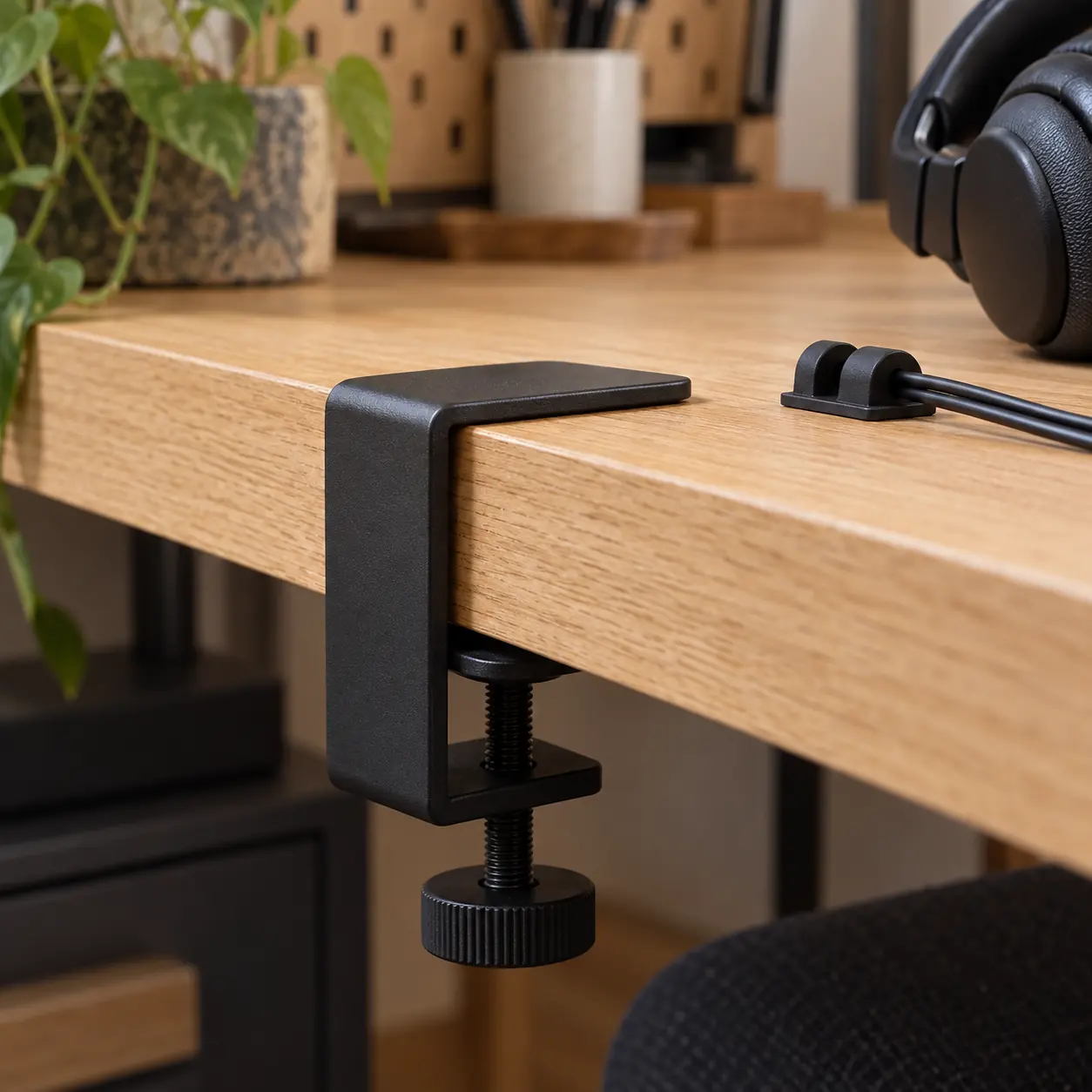
Account for edges that are not square
Rounded, chamfered, and sloped desk edges can reduce the contact area of a clamp pad. A large advertised opening does not guarantee that the pad will sit squarely on a curved profile. The question is whether the clamp meets two stable surfaces, not whether it can be forced over the edge.
Sketch the edge profile from the side and compare it with the holder manual or close-up photography. If the maker does not describe edge compatibility, treat that as an unanswered question. Pressure against a tiny corner is different from an even grip on a flat lower face.
An underside obstruction can turn the most visible edge into the least usable installation point. For this guide, account for edges that are not square is the immediate checkpoint; record the observed condition and its next question before moving to another desk decision.
Separate surface protection from fit
A soft pad can reduce direct contact with a finish, but it does not convert an unsuitable edge into a suitable one. Veneer, laminate seams, soft wood, and painted surfaces deserve a cautious check before a clamp is tightened. Surface care is an installation consideration, not a promise of damage prevention.
Place a small piece of clean paper on a hidden part of the chosen area and see whether the contact zone remains flat. Do not use the paper as a permanent shim unless the holder instructions permit it. This brief observation keeps material sensitivity visible without improvising a structural fix.
A finish question belongs in the record before a screw transfers pressure into the surface. For this guide, separate surface protection from fit is the immediate checkpoint; record the observed condition and its next question before moving to another desk decision.
Leave room for daily movement
A promising edge can still be poorly placed if a desk chair, drawer, keyboard tray, or wall clearance passes through the same space. Headphones need a route on and off the hook; the cable needs a route that survives the same movement. Think about the entire reach, not only the clamp.
Sit at the desk and move through the usual actions: pull the chair in, open the nearest drawer, set down a bag, and turn toward the headset. Mark any collision with low-tack tape before installing. The tape is only a planning mark, but it exposes a conflict before hardware is tightened.
A drawer sweep is a moving boundary, not empty space that can be assigned to a hook. For this guide, leave room for daily movement is the immediate checkpoint; record the observed condition and its next question before moving to another desk decision.
Write a short fit record
A short fit record keeps a comparison calm. Include desktop thickness, underside obstacles, edge shape, finish concern, nearby moving parts, and the intended headset side. The record can be reviewed against product documentation or a seller answer without turning a desk photo into proof of compatibility.
A clear no-fit result is useful. If the edge lacks a parallel surface or the only available location conflicts with a drawer, another mounting method may be more sensible. The point of the audit is to avoid treating a clamp as universally adaptable when a specific desk has already supplied a limit.
A rejected edge is useful information when it is rejected for a documented physical reason. For this guide, write a short fit record is the immediate checkpoint; record the observed condition and its next question before moving to another desk decision.
What this check carries forward
Treat the desk edge as a small site survey. A high-quality desktop can still have only a few useful clamp zones because construction details gather at the same perimeter: a cable grommet at one end, a drawer slide below the centre, an apron on the return, and a wall at the back. A short survey prevents the tempting but costly assumption that the most visible edge is the only one worth considering. It also makes a seller question sharper: ask whether the clamp requires a fully flat lower surface, rather than asking a vague question about whether it works with a desk.
When a desk has a delicate finish or a built-up edge, preserve uncertainty rather than trying to defeat it with extra material. A large felt pad, folded card, or stacked tape can change how a clamp transfers pressure and can make the holder sit crooked. The responsible record is often simply “finish needs manufacturer guidance” or “edge lacks a parallel underside.” That result respects both pieces of furniture. It also makes a future decision easier because the reason for rejecting the spot is written down rather than forgotten after a rearrangement.
The audit becomes useful again whenever the desk changes. A new monitor arm, keyboard tray, power strip, or filing cabinet can reduce the clearance that originally made a clamp location work. Revisit the tiny map before moving the holder. This prevents a desk reset from becoming a series of unexplained placements, and it keeps the clamp choice connected to the furniture it actually touches.
Before ordering or mounting anything, keep the edge record beside the product details: top thickness, lower clearance, profile, finish, and moving objects. This is enough to ask a manufacturer a concrete compatibility question or to reject a location cleanly. It also makes clear why a generous clamp range may not settle the decision. The desk is not a generic rectangle; its usable edge is a particular small landscape.
An edge audit is complete only when it gives the next decision a physical boundary. Keep the measured gripping zone, the underside obstruction, and the moving-object clearance together in the same note. If the clamp later seems awkward, revisit the map instead of relying on a memory that the desk once looked flat. The record can also be shared with a desk owner or product maker as a focused question: this is the thickness, this is the lip, and this is the hardware below it. That is more useful than asking whether a holder fits a desk in general, because it preserves the exact feature that needs an answer.
Use the next note, not a bigger claim
After the edge is mapped, use the clamp-pressure note only if the selected zone gives the pads two stable faces. If that condition is absent, move to clearance or another storage method instead of trying to solve an edge-shape question at the tightening screw. The audit has already narrowed the choice to a real desk condition.
Return to the main Deskline Register field report for the comparison method, then consult cable mapping if the chosen zone remains usable. An edge record and a route map describe different parts of the same setup, so neither should be used as proof of the other.